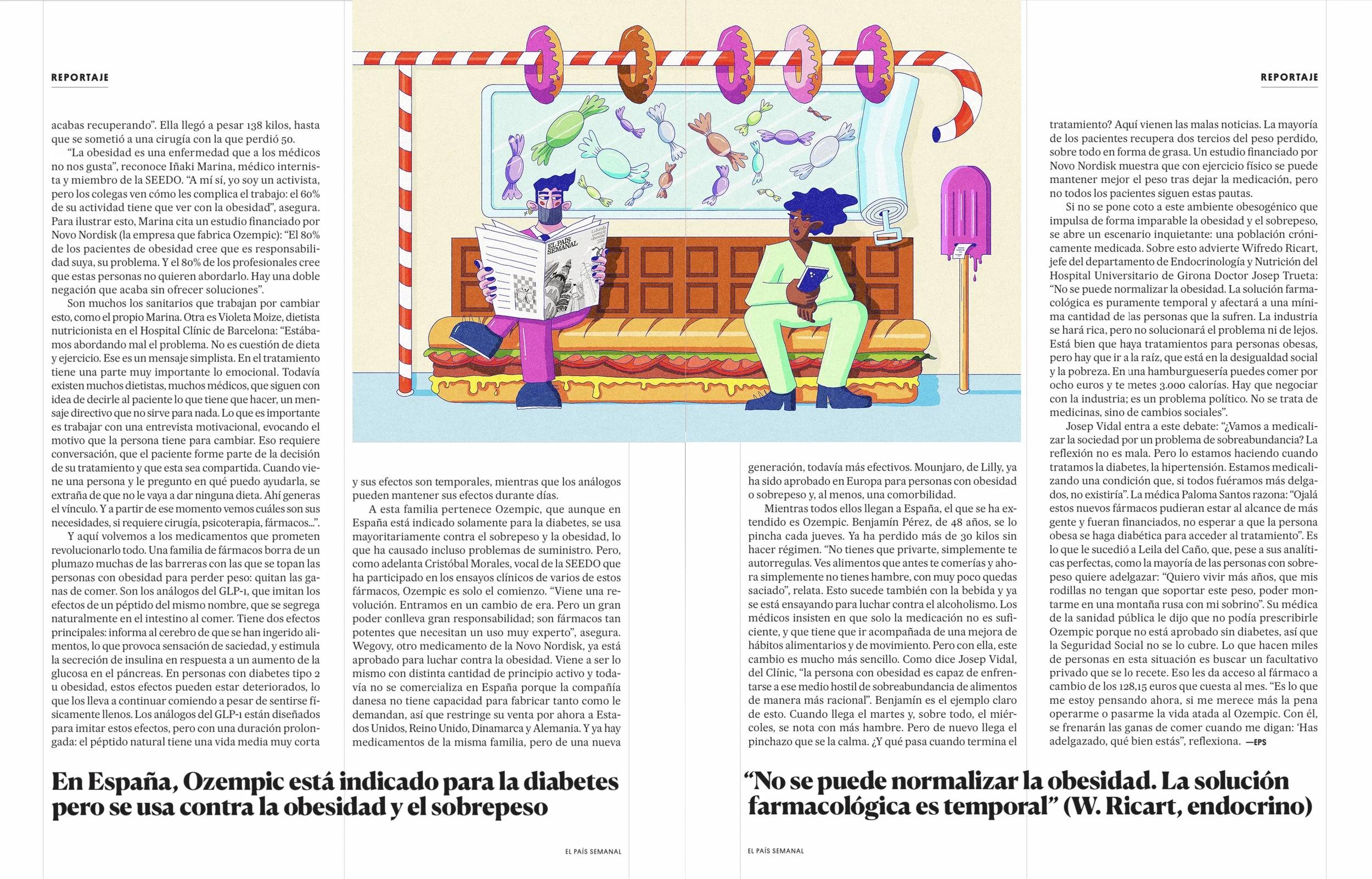
The battle against obesity
Master’s final project
The project consists of creating an illustrated editorial feature based on the text “The Uncertain Revolution Against Obesity”, which addresses obesity as a complex issue linked not only to individual factors, but also to structural causes such as social inequality, environment, and consumption habits.
The assignment requires the development of a coherent illustration system capable of visually translating the article’s main concepts, avoiding literal approaches and instead favoring a conceptual and critical interpretation.
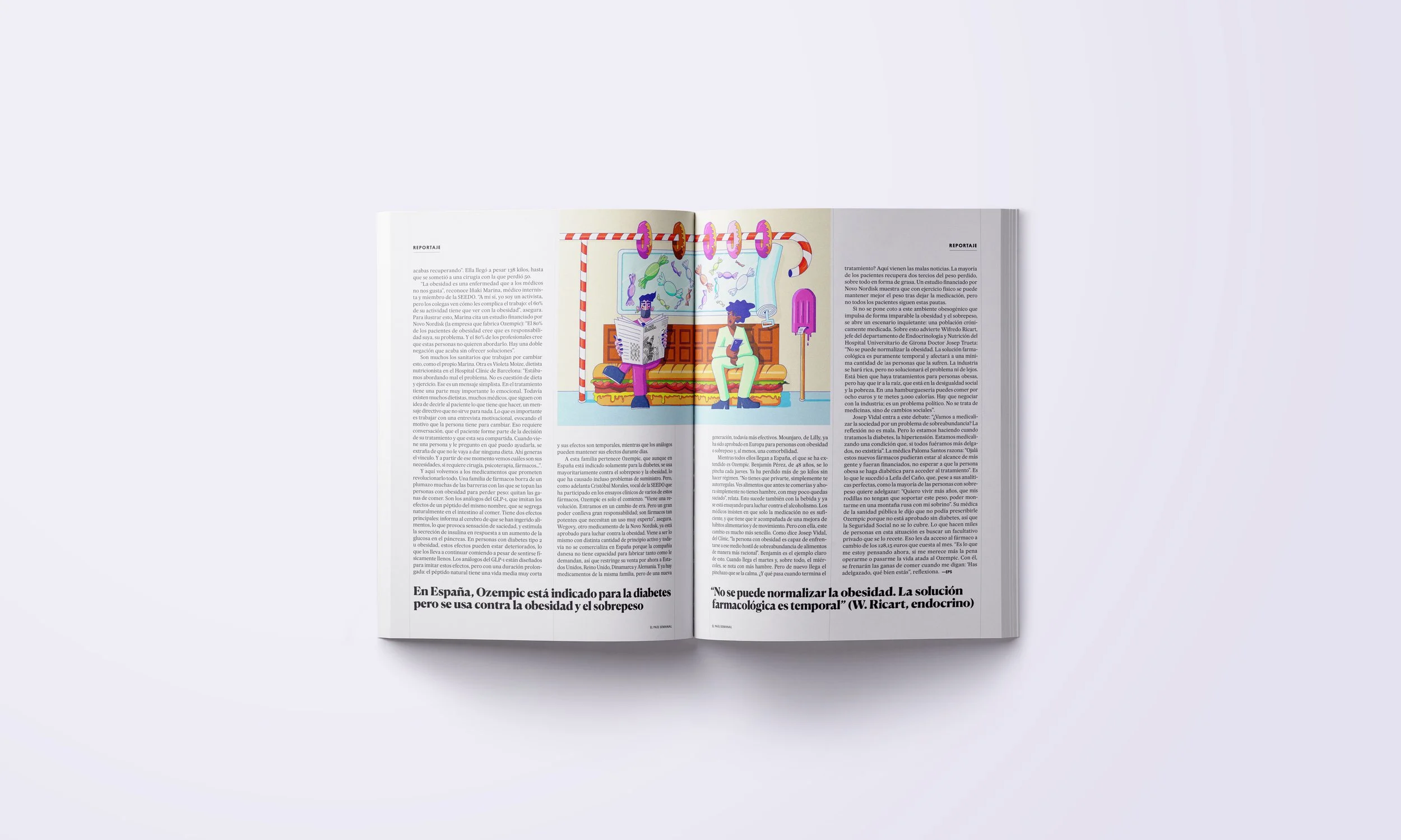
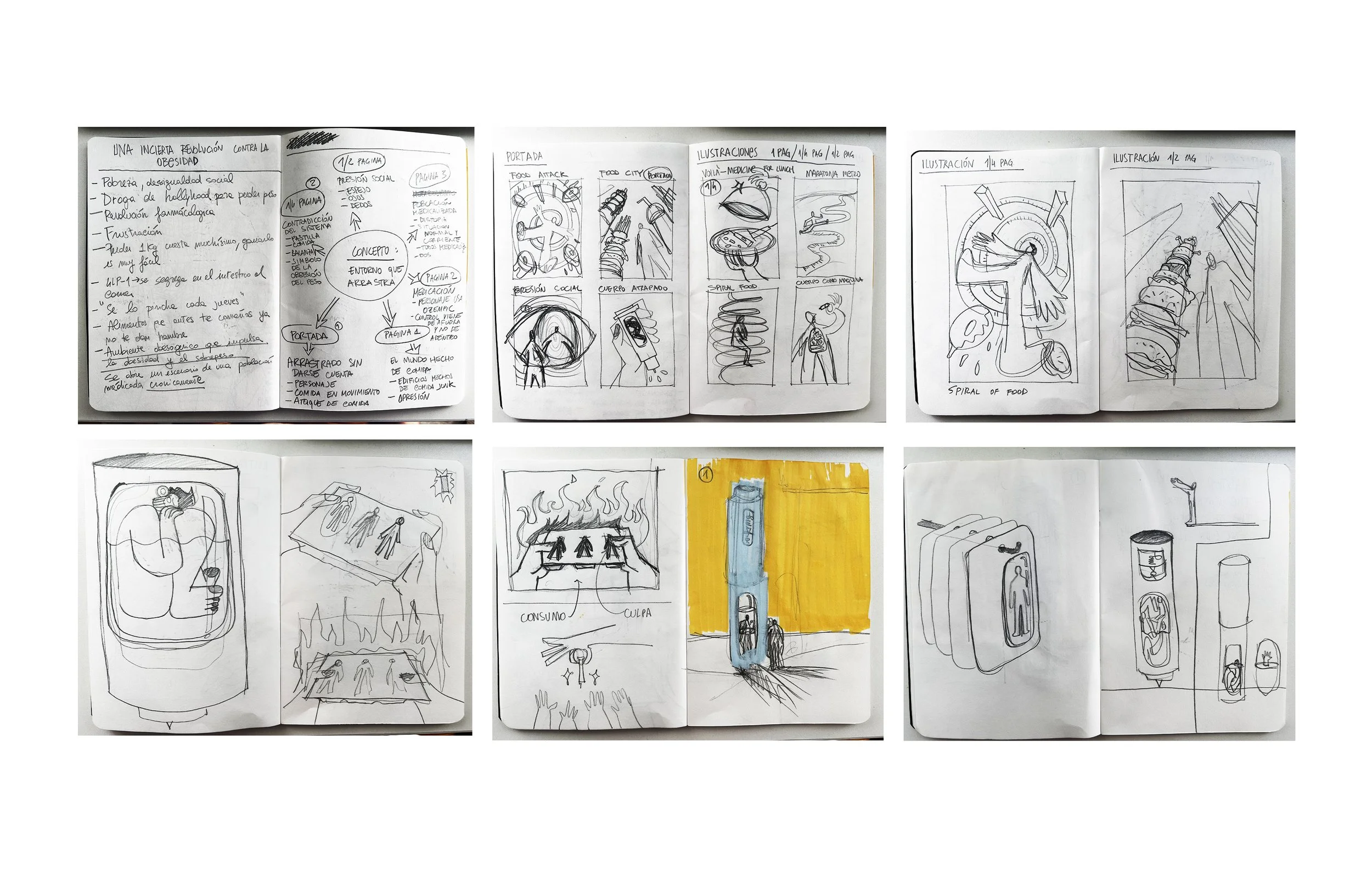
The concept
The project proposes a critique of the contemporary capitalist system, in which the constant consumption of ultra-processed food coexists with the imposition of thinness as a normative ideal.
Through this series of illustrations, a visual narrative is constructed to show how the individual becomes trapped in an environment that encourages excess while simultaneously demanding its correction, generating a continuous cycle of consumption, guilt, and control. In this context, the body ceases to be an autonomous entity and instead becomes a space subjected to intervention, shaped by external factors and by solutions that fail to address the root of the problem.
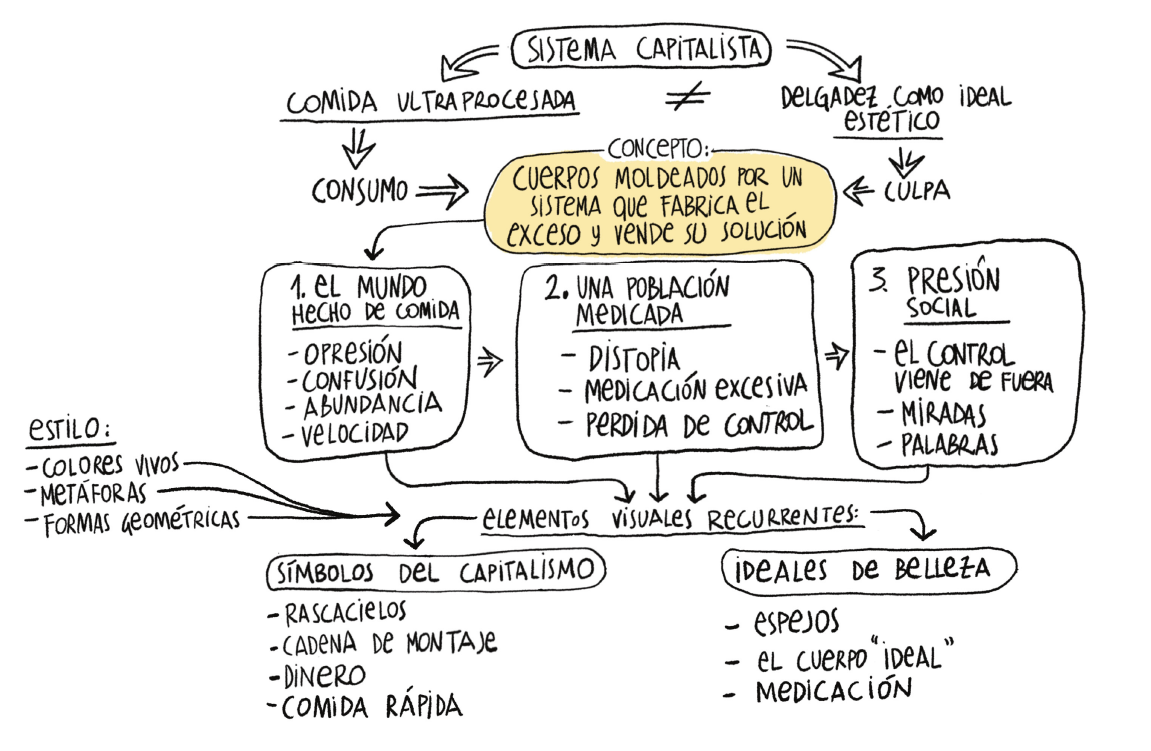
City of Consumption
The scene presents a dreamlike situation in which a character, seen from behind and wearing underwear, as if opening the refrigerator at night, faces a surreal landscape composed of gigantic foods rising like skyscrapers, symbolizing a world saturated with constant stimuli, especially those linked to immediate pleasure. The character, diminished in scale before this overwhelming setting, is confronted with a dimension greater than themselves, where desire appears amplified and difficult to control.
In this context, the individual adopts an almost heroic attitude: as if they were a knight facing a challenge, they use medication, represented by Ozempic, as a tool to try to contain those impulses.
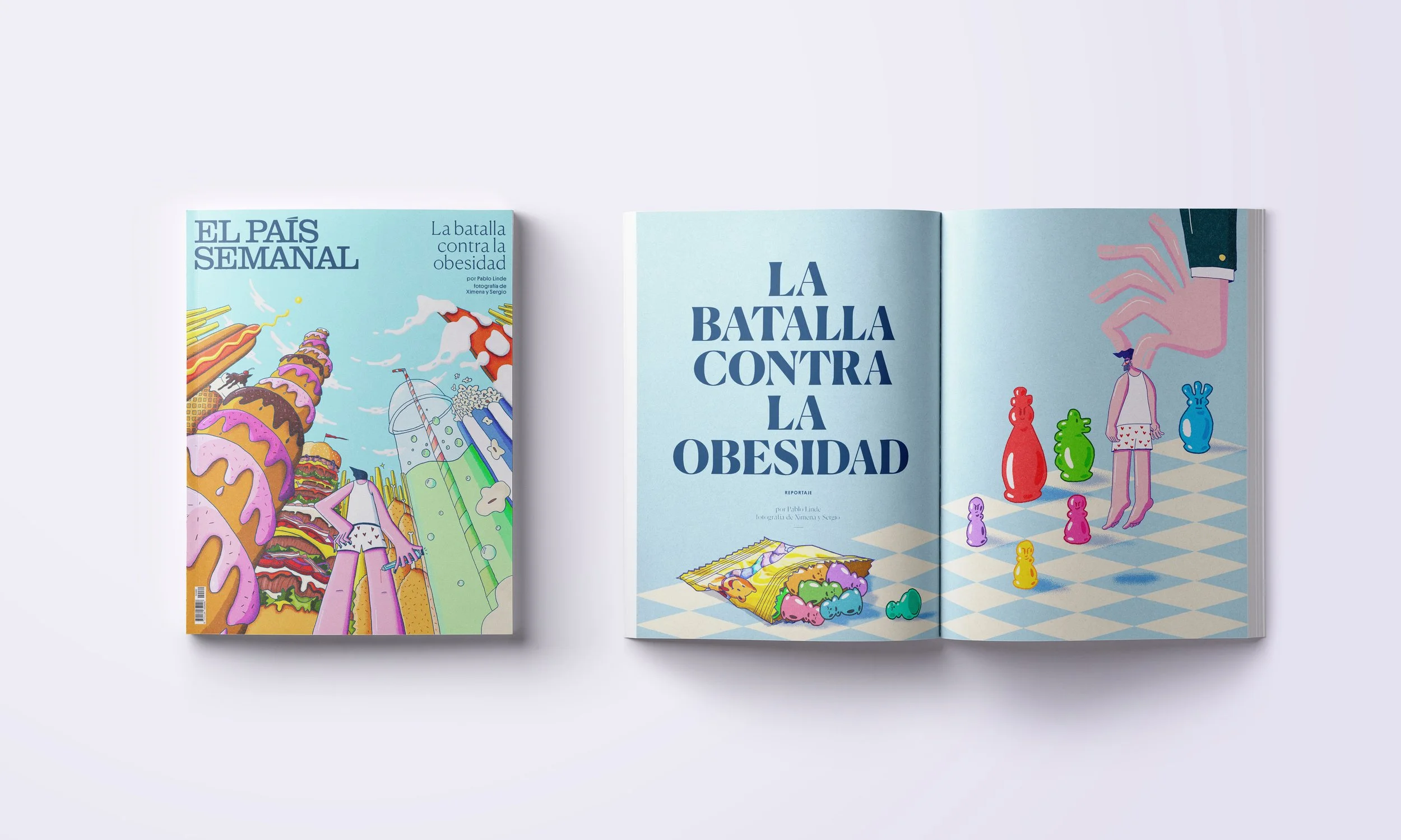
Problem and solution
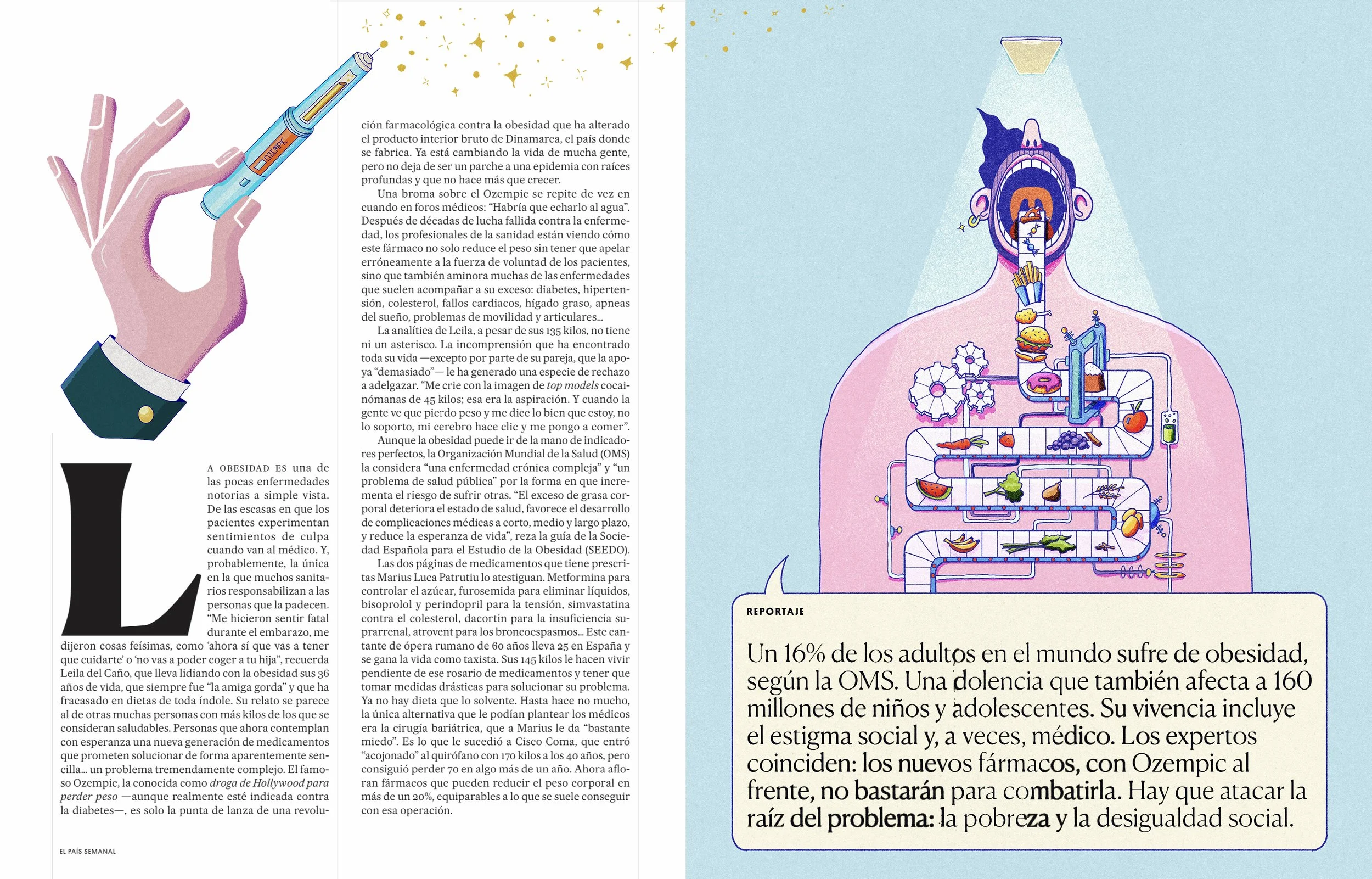
The two illustrations establish a contrast between the problem (on the right) and its apparent solution (on the left).
In the image on the left, the medication is not presented as a conventional medical resource, but rather as a kind of magic wand that promises an immediate, simplified, and almost miraculous solution. In the image on the right, the body is depicted as a system in which consumption does not stem from fully conscious decisions, but from mechanical and structural dynamics. The scene shifts the responsibility for obesity away from individual willpower and toward the surrounding environment.
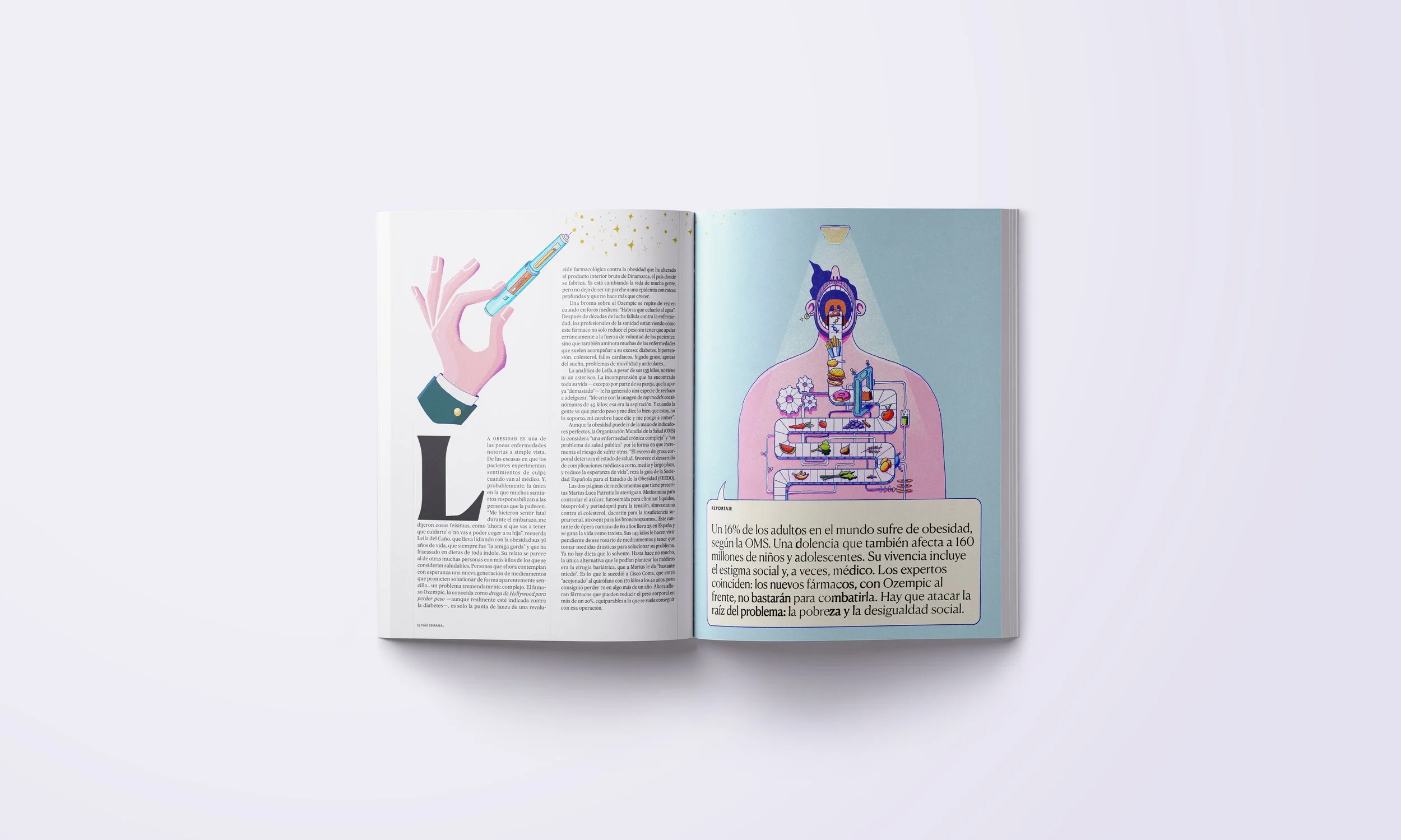
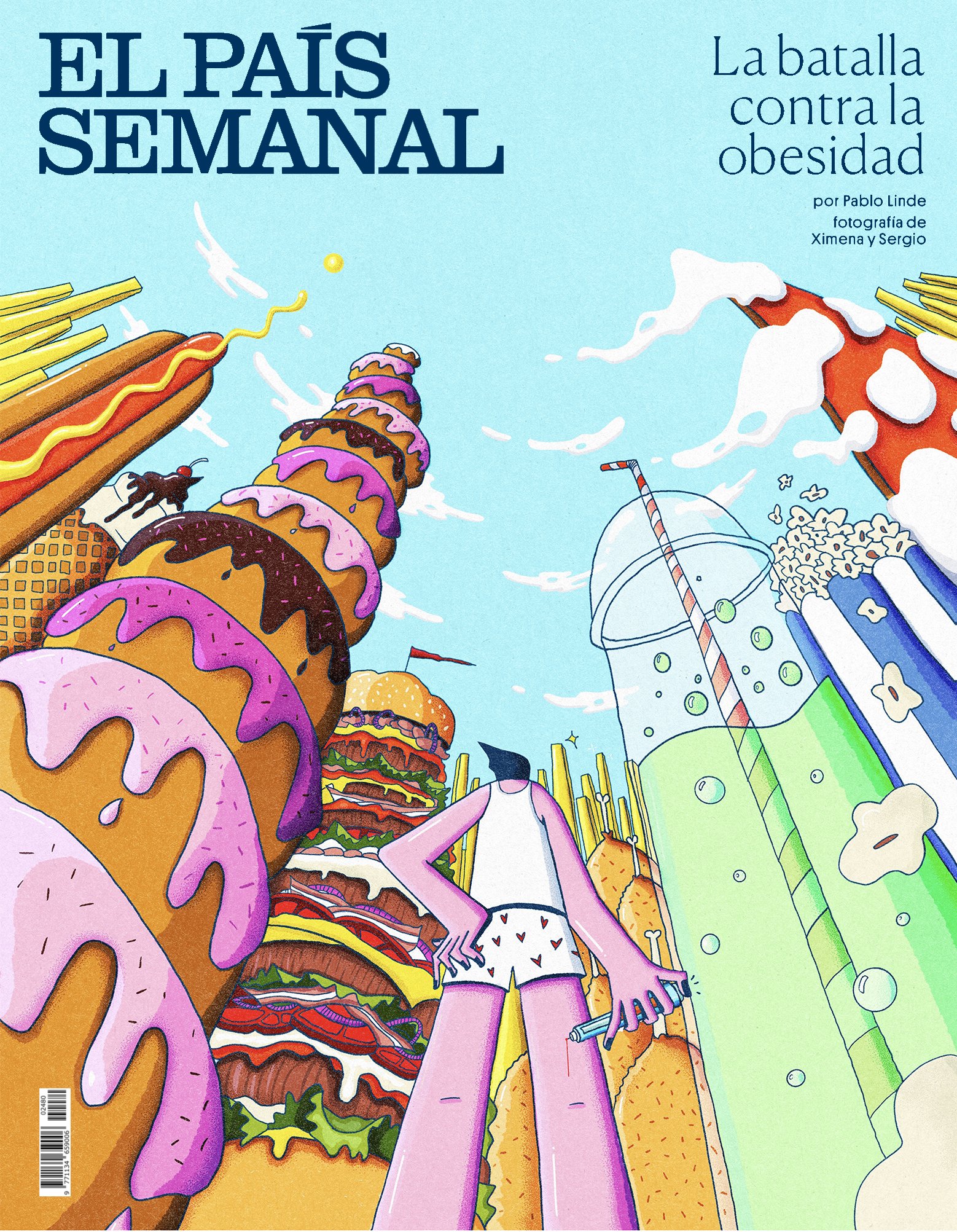
Food subway
The scene presents an environment in which the consumption of ultra-processed products does not appear as an individual choice, but rather as a structural condition. Everyday space is completely colonized by food, which becomes part of the ordinary landscape.
This integration is so pervasive that individuals perceive no anomaly: what should appear strange is instead accepted as normal, revealing the extent to which consumption has been naturalized.
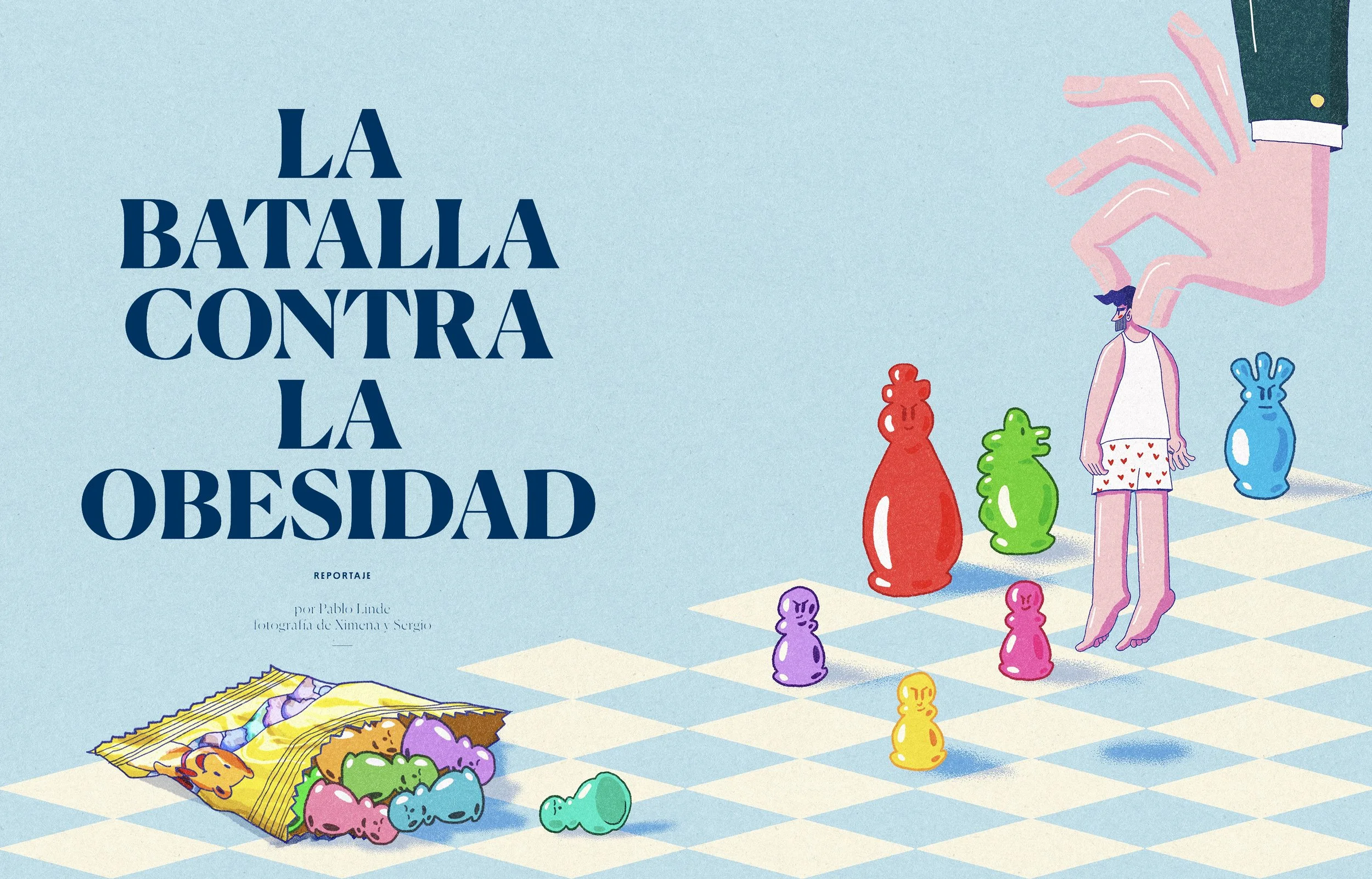
Board of Consumption
The character is presented as just another piece on a game board, suggesting that their decisions are not entirely autonomous, but rather conditioned by an external force, represented by a large-scale hand intervening in the scene.
The playful and seductive nature of the candies used as game pieces disguises a system that operates subtly, where pleasure and consumption are part of the same mechanism.
The individual thus appears trapped within a structure in which they do not truly make decisions, but instead function like a pawn in a game where they are not the player, but the object.
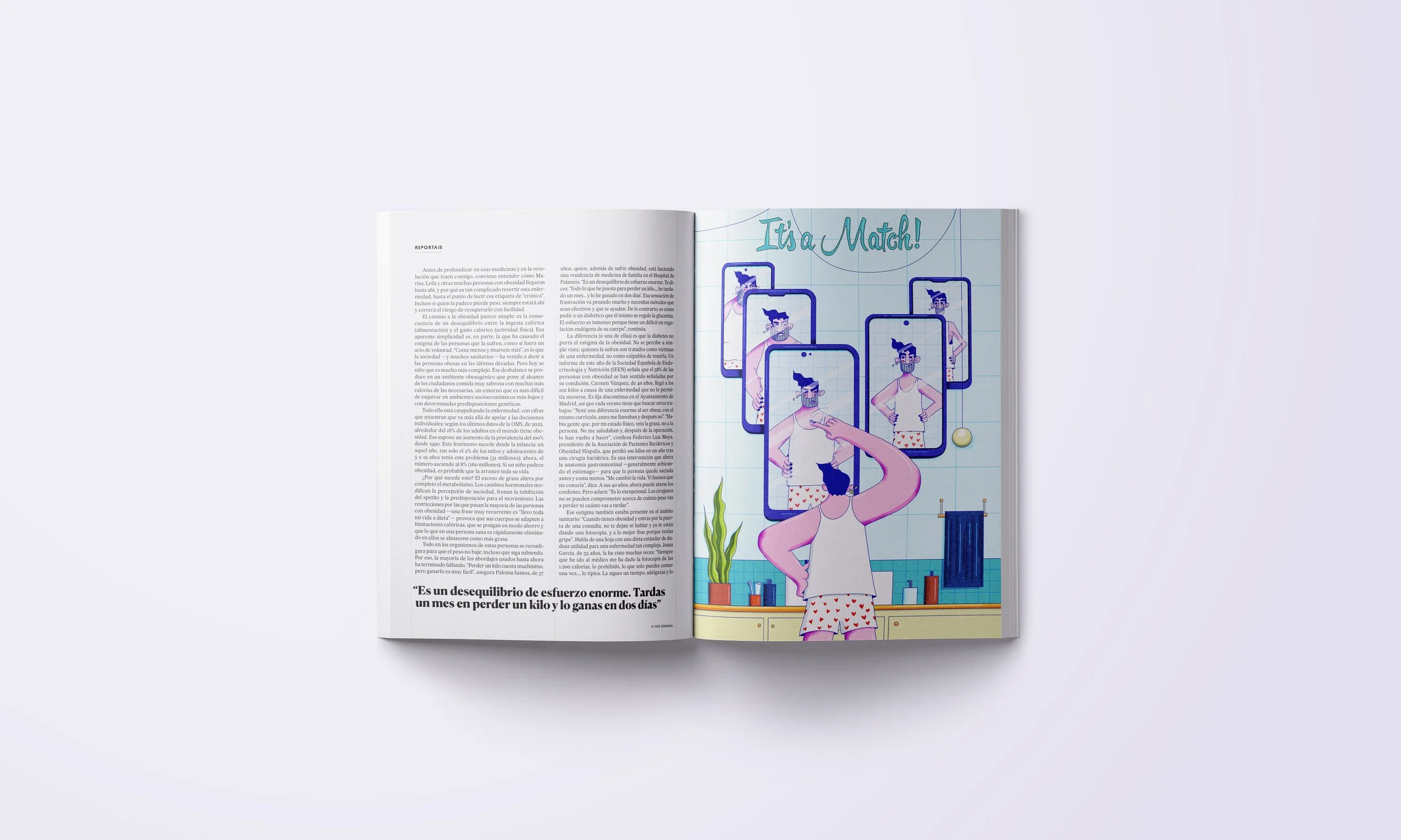
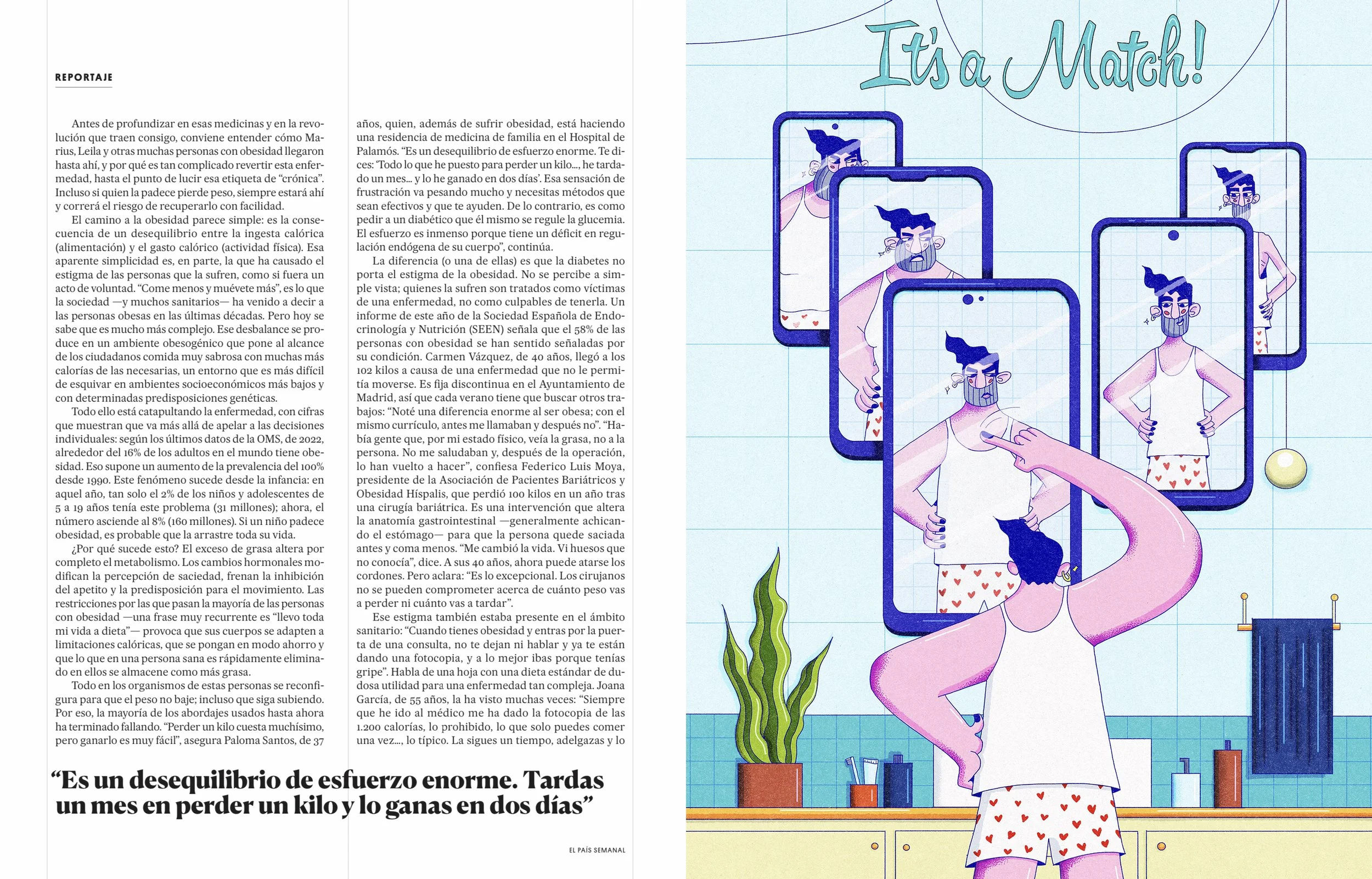
It’s a match! (is it?)
The illustration addresses the construction of bodily identity as a process mediated by external standards, in which the body becomes an object of selection, validation, and consumption. The mirror fragments into multiple versions of the character, presented as if they were profiles within a dating app. The individual interacts with these images by swiping, as though they could instantly choose which version of themselves they wish to become. Each reflection embodies a different ideal: thinner, more normative, and closer to imposed beauty standards.
In this way, the intimate act of looking at oneself in the mirror is transformed into an experience of consumption: the subject no longer recognizes themselves, but instead begins to select themselves.